
Joint-Friendly Exercises After 40: 5 Low-Impact Moves for Strength, Mobility, and Healthy Knees
Picture this: You roll out of bed, plant your feet on the floor, and there's that familiar twinge—a subtle stiffness in your knees or hips that wasn't there a decade ago. If you're over 40, you're not alone. Morning creaks and afternoon aches have become part of the landscape for many of us as collagen dips and daily wear accumulates. But here's the good news: you don't need high-intensity spins or pounding runs to fight back.
Joint-friendly exercises after 40 offer a smarter path. These low-impact strength builders and mobility moves target the muscles around your knees and hips, fostering resilience without the jolt. Designed for those noticing stiffness, they emphasize controlled motion, breath, and consistency—hallmarks of fitness over 40. In this guide, we'll explore five knee-friendly workouts that deliver real results: enhanced stability, smoother strides, and that satisfying post-move looseness.
No gym required, just a chair, wall, or mat. Ready to reclaim fluid movement? Let's dive in.
The 5 Joint-Friendly Exercises for Low-Impact Strength and Mobility Over 40
These moves prioritize healthy joints by strengthening supporting muscles like glutes, quads, and core—without compression or twist. Perform them mindfully, breathing deeply, and stop if anything pinches. Aim for quality over quantity.
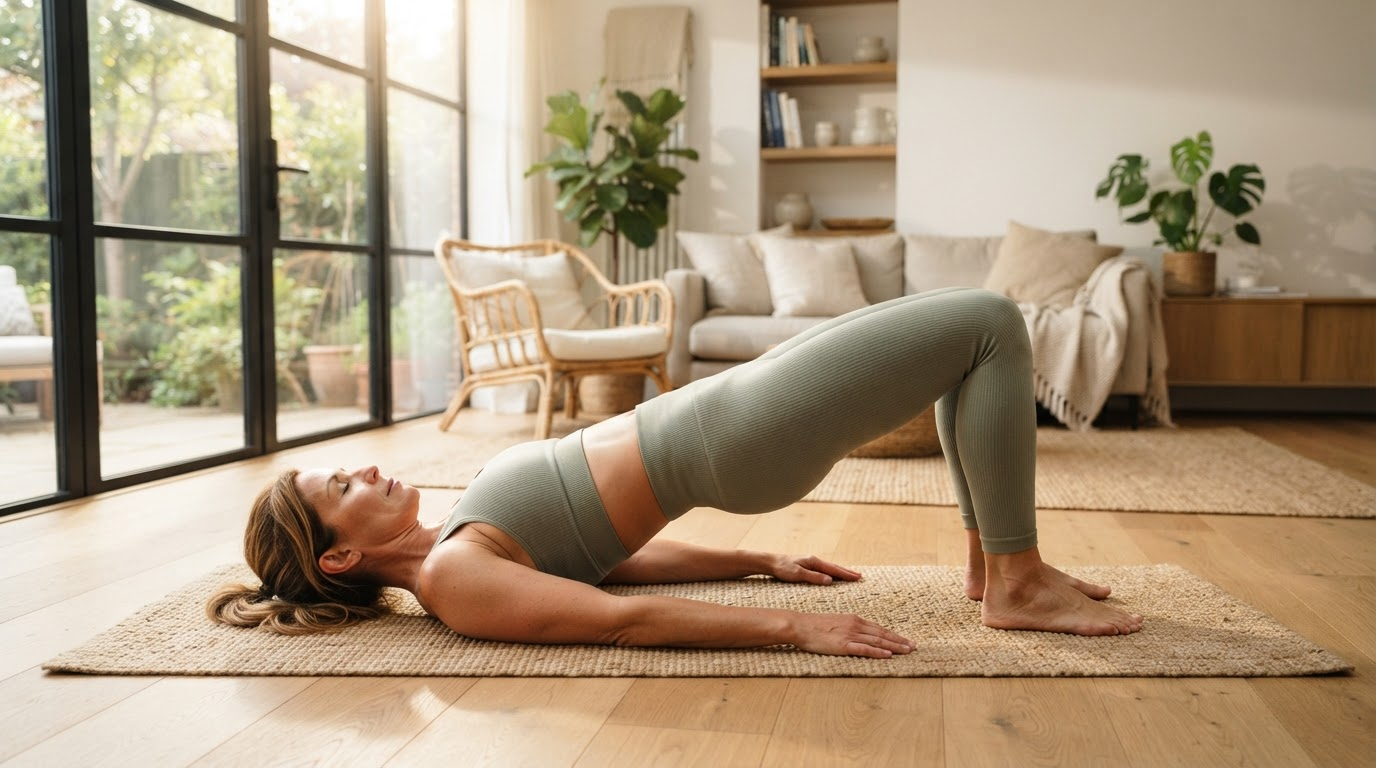
1. Glute Bridge: Wake Up Your Posterior Powerhouse
This classic zeroes in on glutes and hamstrings, the unsung heroes stabilizing your knees. It feels like a gentle lift that unsticks tight hips, leaving you grounded and tall.
Lie on your back, knees bent, feet flat hip-width apart. Arms at sides, palms down.
- Exhale and press feet into the floor, lifting hips toward the ceiling. Squeeze glutes at the top—keep knees tracking over ankles, no splaying.
- Hold 2-3 breaths, then lower slowly, vertebra by vertebra.
Sets and reps: 3 sets of 10-12. Rest 30 seconds between.
Form cues: Chin tucked, core lightly engaged—no arching low back. If it's too much, do single-leg versions propped on a chair.
Why it feels good: That glute burn promotes better hip-knee alignment, easing daily steps.
2. Straight-Leg Raise: Quad Tune-Up Without the Squat
Perfect for knee-friendly workouts, this isolates the front thigh muscles crucial for knee support. It delivers a subtle lengthening that combats desk-bound tightness.
Sit tall in a sturdy chair, back straight, hands on thighs or chair edges for stability. Extend one leg straight out, heel flexed.
- Engage your quad (feel it tighten), lift the leg 6-12 inches if comfy—hold parallel to floor.
- Breathe steadily for 5 counts, then lower with control. Switch legs.
Sets and reps: 3 sets of 8-10 per leg. Pause 20 seconds between sides.
Form cues: No knee lockout—soft bend okay. Keep pelvis neutral; if wobbly, hold the chair seat.
Why it feels good: The slow descent builds endurance, smoothing out that morning hesitation.
3. Clamshell: Hip Sidekick for Balanced Mobility
Target outer hips to prevent inward knee collapse. This low-impact strength move opens up mobility over 40, feeling like a secret stretch mid-strength session.
Lie on your side, knees bent 90 degrees, hips stacked. Head on arm or pillow, top hand on hip.
- Inhale, then exhale to lift top knee like opening a clamshell—keep feet touching, hips still.
- Pause at top, lower with resistance. Repeat, then switch.
Sets and reps: 3 sets of 12-15 per side.
Form cues: No rocking back—stay stacked. Use a resistance band above knees for progression.
Why it feels good: It unlocks lateral freedom, making side steps or stairs feel effortless.
4. Bird Dog: Core-Knee Harmony
A full-body balancer that links core to limbs, promoting healthy joints via stability. Expect a poised, elongated sensation post-set.
On hands and knees, wrists under shoulders, knees under hips. Core drawn in.
- Exhale, extend right arm forward, left leg back—parallel to floor, hips level.
- Hold 3-5 breaths, gaze down, return slowly. Alternate.
Sets and reps: 3 sets of 6-8 per side.
Form cues: No hip sway—imagine a glass of water on your low back. Modify on all fours with arm/leg lifts separate.
Why it feels good: It fosters coordination, reducing knee wander during walks.
5. Wall Slide: Shoulder-to-Knee Mobility Flow
Stand against a wall for upright posture work that ripples down to knees. This joint-friendly exercise enhances overhead reach and lower-body glide.
Back, shoulders, head, and heels to wall, elbows bent 90 degrees, hands up.
- Inhale arms up overhead, sliding forearms—keep contact if possible.
- Exhale to lower, elbows leading. Repeat smoothly.
Sets and reps: 3 sets of 10-12 slides.
Form cues: Low back flat—no arching. Bend knees slightly for comfort.
Why it feels good: The chain reaction loosens upper and lower body alike.
Building Your Weekly Flow: Consistency Without Overload
Fitness over 40 thrives on rhythm, not rigor. String these into a 20-30 minute circuit 3-4 days a week—say, Monday, Wednesday, Friday, with rest or walks in between.
- Warm-up: 5 minutes marching in place or gentle arm circles.
- Circuit: Do one set each exercise, rest 1 minute, repeat 3x.
- Cool-down: Seated forward folds or calf stretches, 2 minutes.
- Progress: Add holds or reps weekly; track how knees feel during hikes.
Pair with hydration, sleep, and anti-inflammatory foods like berries. Listen to your body—stiffness fading signals success.
Common Mistakes to Sidestep for Healthy Joints
Even simple moves trip us up. Avoid these for true low-impact strength gains:
- Holding breath—exhale on effort for calm control.
- Rushing reps—slow is smooth, building real mobility over 40.
- Ignoring alignment—use mirrors or record yourself.
- Skipping rest—joints need recovery to adapt.
- Pushing pain—discomfort yes, sharp no.
Patience pays: In weeks, expect easier mornings and confident movement.
A Gentle Note on Your Wellness Journey
These joint-friendly exercises after 40 are tools for empowerment, drawn from time-tested practices. Yet, this is educational information, not medical advice. Bodies vary—consult your clinician before starting any new routine, especially with existing conditions.
Step into this with curiosity. Your knees, carrying you this far, deserve the care. Here's to strides that whisper, not groan.